
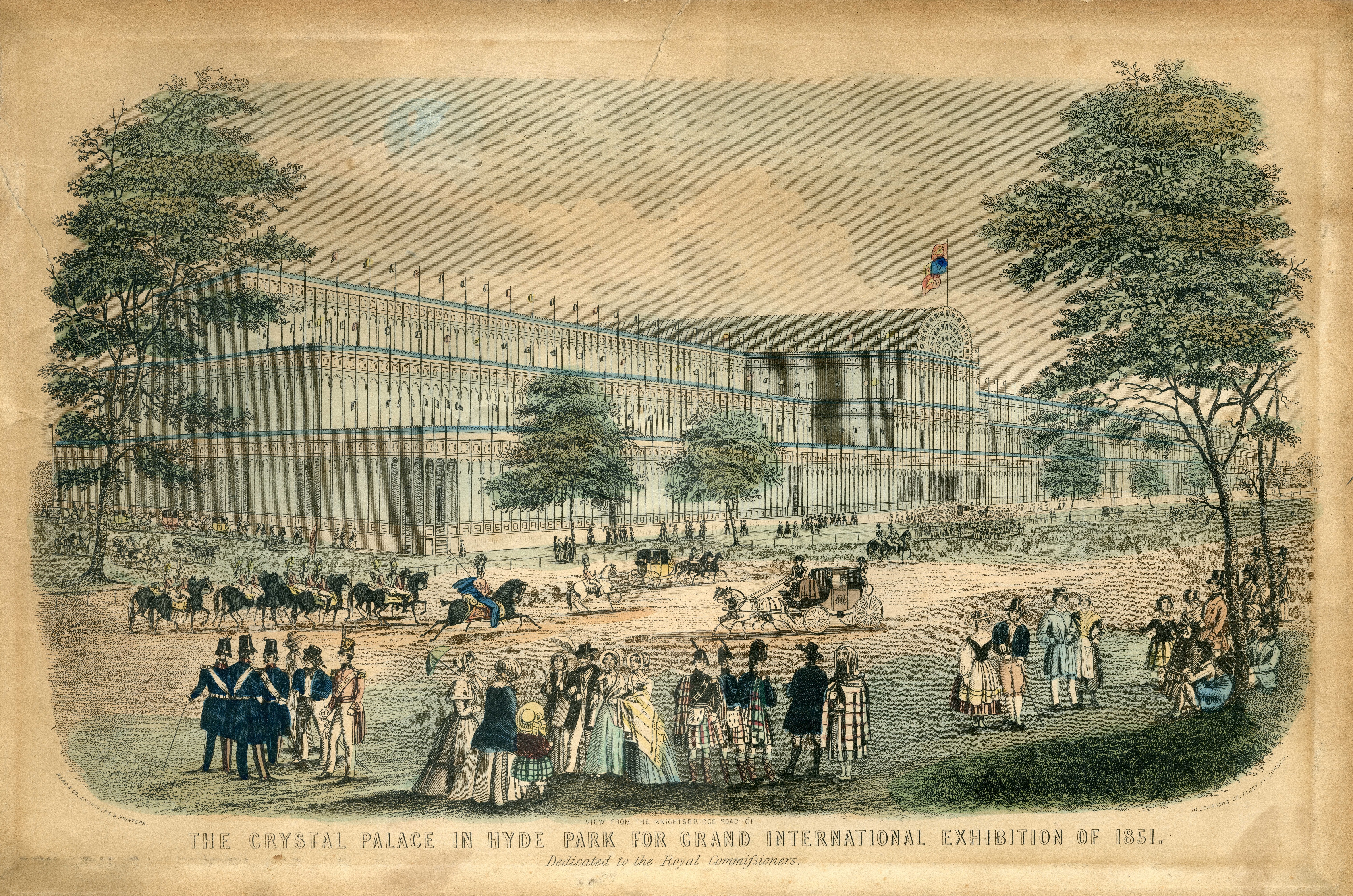
In episode 189 we travel back to 1851, a year brimming with momentous events. On one side of the globe, London was hosting the Great Exhibition, an illustrious display of industry and culture. On the other, the Eastern Cape of South Africa was engulfed in one of its bitter Frontier Wars. Join me as we weave through these disparate, yet curiously interlinked moments in history.

The Great Exhibition of 1851: A Glimpse into the Future
The Great Exhibition, officially known as the Great Exhibition of the Works of Industry of All Nations, was a spectacular event held from May to October in Hyde Park, London. Also called the Crystal Palace Exhibition due to its iconic glass structure, it was the first of many World’s Fairs that would shape the cultural and industrial landscape of the 19th century.
Not just a celebration of industrial prowess, the Great Exhibition was a who’s who of intellectuals, writers, and innovators of the time. Karl Marx, Charles Darwin, Michael Faraday, and Samuel Colt mingled with literary figures such as Charlotte Brontë, Charles Dickens, Lewis Carroll, and George Eliot. Even the famous drink brand Schweppes played its part as the official sponsor, symbolising the merging of consumer culture and industrial progress.
The British were keen to use this exhibition to showcase their technological and industrial dominance. Over six million people visited, roughly one-third of Britain’s population at the time. Thomas Cook, in a rather entrepreneurial move, handled much of the travel arrangements and turned a significant profit, which he later used to establish London’s famous Victoria and Albert Museum, the Science Museum, and the Natural History Museum.

Inventions and Innovations
Amidst the glittering array of exhibits, there were fascinating innovations on display. For example, inventor Frederick Bakewell showcased an early prototype of what would eventually become the fax machine. The New Zealand exhibit, a crowd favourite, featured traditional Maori crafts, including flax baskets and carved wooden objects.
Despite the festive atmosphere, the presence of individuals like Karl Marx provided an intriguing counter-narrative. Marx, deeply engaged in analysing the injustices of capitalism, walked among the symbols of industrial progress, perhaps already formulating his critiques of the very system the exhibition was celebrating. The juxtaposition of revolutionary ideals against the backdrop of Britain’s industrial pride is a reminder of the tensions that simmered beneath this grand spectacle.

The War on the Other Side of the Empire: Cape Colony’s Turmoil
While London celebrated industrial innovation, the British colony of the Cape was embroiled in the 8th Frontier War, a much less glamorous affair. Colonel Henry Somerset and Colonel Fordyce were leading British troops against amaNgqika chief Maqoma and his Khoekhoe and amaXhosa allies, who were proving to be a thorn in the side of the colonial authorities.
The Waterkloof ridges, west of Fort Beaufort, became a key battleground where the Khoekhoe, including former Cape Mounted Riflemen, showcased their understanding of British military tactics. This was a particularly alarming development for the British, as the rebels used their knowledge of British bugle calls and military organisation to devastating effect.
Uithaalder, a key Khoekhoe leader, had turned the rebels into a disciplined force. Drilling his men in the European style of warfare, complete with sentries and roll calls, Uithaalder had created a hybrid military force that combined the bush warfare expertise of the amaXhosa with European military discipline.
The British Blunders and Fordyce’s Fatal March
As October 1851 rolled around, the British, under Somerset and Fordyce, attempted to dislodge Maqoma from the Amathola Mountains. The terrain was unforgiving, and Maqoma, ever the tactician, led the British forces on exhausting pursuits up and down the steep slopes. Soldiers’ bright red jackets were soon in tatters, turning into patchwork uniforms that ironically provided better camouflage in the dense bush.
In one particularly tragic engagement, Colonel Fordyce led a column into a poorly conceived ambush. The British forces found themselves facing a well-prepared Khoekhoe and amaXhosa contingent, and Fordyce, while trying to assess the situation, was shot and killed by a Khoekhoe marksman. His death, along with the lives of several other officers and soldiers, marked the day as a costly one for the British.

The Great Cattle Patrol and Ruthless Retaliation
As the British forces licked their wounds from the Fordyce debacle, their commanders grew increasingly desperate to regain control. It was Lieutenant-Colonel William Eyre who led what became known as the “Great Cattle Patrol.” Eyre’s mission was straightforward: punish the amaXhosa by seizing their cattle, a critical resource for the local economy and sustenance.

Over the course of six weeks, Eyre’s patrol managed to capture 30,000 head of cattle, effectively crippling the economy of the amaXhosa. While the British saw this as a victory, back in England, Colonial Secretary Earl Grey was far from pleased. In an astonishingly harsh recommendation, he proposed capturing all Xhosa women, arguing that their role in preparing food made them an essential target in the war effort. Thankfully, cooler heads prevailed, and this monstrous idea was never implemented.

A War of Attrition: Scorched Earth and Exhaustion
The war dragged on into 1852, with the British adopting increasingly brutal tactics. Governor Harry Smith, facing immense pressure to end the conflict, turned to a scorched earth strategy. The aim was to starve the amaXhosa into submission by destroying their crops and food supplies.
Smith dispatched missionary Charles Brownlee to negotiate with Maqoma and Sandile, offering peace in exchange for withdrawal from British-claimed territories. But the amaXhosa leaders were resolute. As their representative Bhotomane explained, they could not accept the terms and would not leave their land.

A Turning Point in Colonial Strategy
By the start of 1852, both sides were exhausted. The British soldiers were demoralised, and discipline began to crumble. Meanwhile, Earl Grey was losing patience with Smith’s inability to bring the conflict to a close. In a stroke of irony, just as Grey was planning to recall Smith, Grey himself was removed from office, his government collapsing due to mounting pressures, including the mismanagement of the 8th Frontier War.
Smith was ultimately replaced by Lieutenant General Sir George Cathcart, a former aide to the Duke of Wellington. As the new commander took charge, the war had already begun to expose the cracks in Britain’s colonial strategy. The idea of self-governance was gaining momentum, and within a decade, the settlers in South Africa would demand greater autonomy.

Conclusion: A Tale of Two Worlds
As we wrap up this episode, it’s clear that 1851 was a year of stark contrasts. While London’s Great Exhibition celebrated the triumphs of industrial progress, the eastern Cape was locked in a brutal struggle for land, sovereignty, and survival. The deaths of men like Colonel Fordyce, and the relentless conflict in the Waterkloof, remind us of the human cost behind imperial ambitions.
Thank you for joining me on this journey through history. If you enjoyed this episode, please rate the podcast on your favourite platforms to help others discover it.
Click here to listen to Episode 189


Leave a Reply