


Vol. 16, No. 64 (Winter, 1937), pp. 207-214
By 1848 the new Governor of the Cape, Sir Harry Smith, had begun to experiment with British expansionism that he’d observed in India, assuming British culture and traditions, the empire’s institutions, were superior to all other. Smith loved to oversimplify complex problems, and the made him a natural expansionist and a man likely to make big mistakes. Within two months of arriving in Cape Town in December 1847, he had extended the frontiers of the Cape Colony to the Orange River in the arid north west of the Cape.
This was between the area known as Ramah and the Atlantic Ocean. He’d annexed the land between the Keiskamma River and the Kraai River Basin in the east, booted out the amaXhosa, and annexed two contiguous areas as seperate British colonies — British Caffraria between the Keiskamma and the Kei River, and a second area that became known as the Orange River Sovereignty between the Orange and Vaal Rivers. More about this in a moment.
Smith eyes the Orange Free State
Back in England, Colonial Secretary Earl Grey accepted what was ostensibly Smith’s fait accomplis with reluctance. He had been told by Smith that the cost of managing all this new land would be met from local taxes.
Now as most of us know, there are only two things certain in life – death and taxes. But the frontier spirit of the time railed against the idea of coughing up cash for Smith’s vision of a British Empire straddling the Orange and Keiskamma Rivers.
The majority of settlers, although appreciating Smith’s military prowess, were totally against the idea of paying his tax. The Orange River Sovereignty in particular was case in point.
Even up to 1872, it’s revenue never exceeded 12 thousand pounds a year, and derived largely from hunting licenses, and taxing of local Boer and English farmers. A land tax. There was no grant-in-aid as it was called from the British empire. The public service in this huge expanse was restricted to the Resident magistrate, Major Henry Warden, four other magistrates in charge of each district, five clerks totting up all the numbers, eight constables, one Dutch Reformed minister, and four school masters.
All of the technocrats were regarded with suspicion, and most were deficient in training and ability according to the various sources. Don’t take my word for it, those critical of these handful of officials capacity include historian de Kiewiet in his work British Colonial Policy and the South African Republics, not to mention a few damning paragraphis in the autobiography of Harry Smith, as well as in historian van Jaarsveld’s book Eenheidstrewe, and BJ Barnad’s musings in the biography ’n Lewensbeskrywing van Majoor Henry Douglas Warden.
You can’t really blame Smith — one of the reasons for his rushed decision on the Orange River Sovereignty was the response from the TrekBoers and one in particular. That was Andries Pretorius, the highly experienced Voortrekker leader.
So it was in January 1848 that Governor General and Commander in Chief Sir Harry Smith rode into the region on the border between Natal and the Orange Free State with the intention of settling various challenges with the trekkers.
This is where there’s a debate about what happened, perhaps it was those pesky translators messing about again, but Pretorius was made to understand that the British would not annex the high veld territory until Boers had been consulted.
Only after the Volks decision, would Pretorius report back to Smith about their view of his annexation. Relations between the two were icy to put it mildly. If you recall, the British and the Boers had already had a skirmish in 1846, where Major Warden had dispersed a force of trekkers after clashes with the Griqua in the south west of the Orange Free State. After this, Warden had been appointed as British Resident of the Free State and was stationed at Bloemfontein with a handful of troops.
A Sudden Annexation
Then suddenly, on the 3rd February 1848 Smith annexed the Orange River Territory, and an indignant Pretorius immediately embarked on a tour of the high veld Boer settlements from Winburg to the Soutpansberg to stir up opposition. Smith on the other hand headed back to Cape Town, happy in the knowledge that he’d extended the British empire further into southern Africa.
Pretorius was so incensed that he began fanning the flames of anti-British opposition, or probably to be more accurate, anti-Smith opposition. He put out feelers to Moshoeshoe, the Portuguese governor at Delagoa Bay aka Maputo, and even Mpande of the AmaZulu.
None of the African chiefs would have anything to do with him, neither would the Portuguese Governor. The bitter resentment at Smith’s unilateral action amongst the trekkers grew, and Warden was now in a particularly exposed position with his total force of 8 constables facing the hundreds of angry Boers of the Free State and Transvaal.
This resentment boiled over in July 1848 when Pretorius with commandants Stander, Kock and Mocke led a powerful force of 200 Transvalers and about 800 Free Staters along with a 3 pounder artillery gun into Bloemfontein. On the 20th July Warden was given terms, surrender or face the consequences. To fight against a force of a 1000 men on horses with his paltry force of 8 would have been suicidal, even for a man steeped in the honour code of the British Army, and he capitulated and agreed to leave.
But he had seen what was coming. A week earlier, on the 13th July Warden had sent an urgent message to Smith from Bloemfontein which arrived in Cape Town on the 22nd July, remarkably quickly if you consider the distance. Smith ordered all troops in Grahamstown and adjoining districts to mobilise and march to Colesberg. As I’ve said previously, that little town on the main highway between the High Veld and Cape Town is probably one of the most strategic in South Africa.
Colesberg lies is 400 kilometers north of Grahamstown, so the British infantry marching towards Bloemfontein gave the Boers some time to organise themselves. On the 29th July Smith and his staff left Cape Town and rode directly to Colesberg, arriving there in a truly impressive eleven and a half days, cantering in on the 9th August.
The measured route in 1848 was 615 miles, or 989 kilometres. They say that Smith was a man of action and his riding skills were legendary, but even for the time, this was pushing the envelope.
Into Battle
From Colesberg, Smith led an army of 600 men with 3 Six pounder cannon to the Orange River, where they crossed at Botha’s Drift on the 26th August. It was mid-winter and the veld was brown, the mornings freezing, the days clear and hot.
Smith was not alone. He was traveling with a few dozen Boers who had flipped sides, fighting for the British as well as four companies of the Cape Mounted Rifles. The English were traveling heavy, their oxen dragging 150 wagons which contained ammunition, 30 days of food, and the usual extravagances of the officer corps, silverware and bottles of wine.
The Boers had decided to try and fight the English as soon as they crossed into the Free State, but Pretorius surveyed the area near Botha’s Drift earlier and found there was no fodder available for the Boers horses. So he moved his men just over a hundred kilometers north of Philopolis to a farm called Telpoort and established his laager there.
Smith arrived in Philippolis on the 27th August, and continued moving rapidly towards Bloemfontein. The next day he was around 120 kilometres away, at a place called Visser’s hoek, south south west of Bloem. Adam Kok and 250 of his Griqua men now joined the British, adding a significant amount of firepower and mobility to the British units. The weather was logged as fine and dry, a typical winter’s day in southern Africa.
The Boers knew this country well, but now they faced an army led by a commander who had quite a bit of experience of warfare in southern Africa. Smith was aware that between him and Bloemfontein there was only one place where the Boers could put up a fight, and that was the range of hills in an area known as Boomplaats.
The place of trees.
Before dawn on the 29th August, patrols brought the news that they’d located the Boer position, and it was based in Boomplaats as forecast. Pretorius’ men had also been reccing the British position on the night of the 28th, so both sides knew exactly where the other were. The only mystery was exactly how many men the Boers had managed to mobilise.
Pretorius had decided that Boomplaats gave him the best chance of victory, even though it was an obvious spot. One of the most important principles of warfare was surprise, and Pretorius was laying a trap for the English. He had over 700 men waiting in the koppies alongside a sinuous spruit called Kromellenboog, or Crooked Elbow. If you look at a map of Boomplaats hill and the river nearby, it’s indeed a crooked Elbow, very difficult landscape for an attacking force.
A small road led down into the Kromellenboog, and a shallow drift was the crossing. Just north of this was a Boer homestead, above that, a cattle kraal. About two kilometers south of the crossing is a range of low hills, humps really, that cross the road. This was a blind rise just before the drift.
To the west, or to the left of Smith’s men as they approached along the road, was a hill about half a kilometers away. An excellent spot for a bit of sharpshooting. To the east, Smith’s right, two low hillocks run parallel to the road about fifty metres away. And even better spot for a bit of heavy fire.
About two hundred metres north of the crossing the road crossed a range of hills which lie quite close to the stream. Pretorius had eyed this part of the landscape with a great deal of interest, because two flanking hills overlooked the road. What a perfect place for an ambush he thought.
The road passed extremely close to the two hills, which were really low lying humps, but were an excellent place for his men to lie in wait, and the humps would give cover to his men’s horses.
By the way, I have managed to find the original British Army report into the battle which is in the Journal of the Society for Army Historical Research, published in 1937. I’ll load the map of the battle site into my blog for reference purposes — if there’s any confusion about all this east and west stuff, just head on to desmondlatham.blog and you’ll find the Boomplaats update front and centre.
The problem for the Boers was there was only one way to escape. To the East, the Krommellenboog River curves away, and has cut a very deep pool that is nearly two kilometers long. There was no escape across that part of the river. Closer to the drift crossing on the road, there were multiple points for horsemen to cross, but below the drift, the rocky river would make for a very difficult gallop. So they’d have to withdraw along the road to the north themselves.
As Smith approached this area, he saw the kopje opposite the crossing, about 200 metres wide and about 400 metres long. It is one of those typical Free State koppies you’ll find in this area, and the cattle kraal was based on the north east face just above the farm buildings. Another ideal spot for the Boers to lie in wait, which is exactly what sections of the Boers were doing.
About a kilometer and a half further on, around the koppie, was the Boer gun, placed on a larger koppie and clearly visible. If the British rounded the little koppie with its cattle kraal, it would open fire on advance parties. What Pretorius hoped was that Smith would spot the gun, and see the few men there, and presume that the entire Boer force was on the hill and not lying in wait near the drift.
Pretorius had set up his main force on the two hills alongside the road, just before the drift. An army crossing a river is in an exposed position and Pretorius was playing a double bluff. But Smith, for all his faults, was no fool when it came to military tactics.
The main force of Transvalers under Pretorius lay in the centre of the hills on the left, with the Free State boers on both sides. Kock and one hundred men were further west, they’d come into play when the British tried to cross the drift — if they made it that far. Commandant Stander and two hundred men lay in wait east of the road, creating a killing field, an arc of death.
It was Stander who would give the game away — if you don’t mind the pun. Because as his men rode to their positions at 11am, they disturbed a herd of wildebeest watering at the large pool I mentioned. These streamed across the front of the Boers main position at exactly the moment that the British advance guard of Cape Mounted Rifles approached. Their commander Lieutenant Warren and a few of his men galloped to the top of the little hill near the road and spotted the Boers.
Smith didn’t hesitate. He ordered the rest of the Cape Mounted Rifles to charge ahead and rode with them, always up for a fight — which is exactly what he got. He had been hoping for some kind of final peace talk before he pitched up to Boomplaats, but the Boers were in no mood to chit chat.
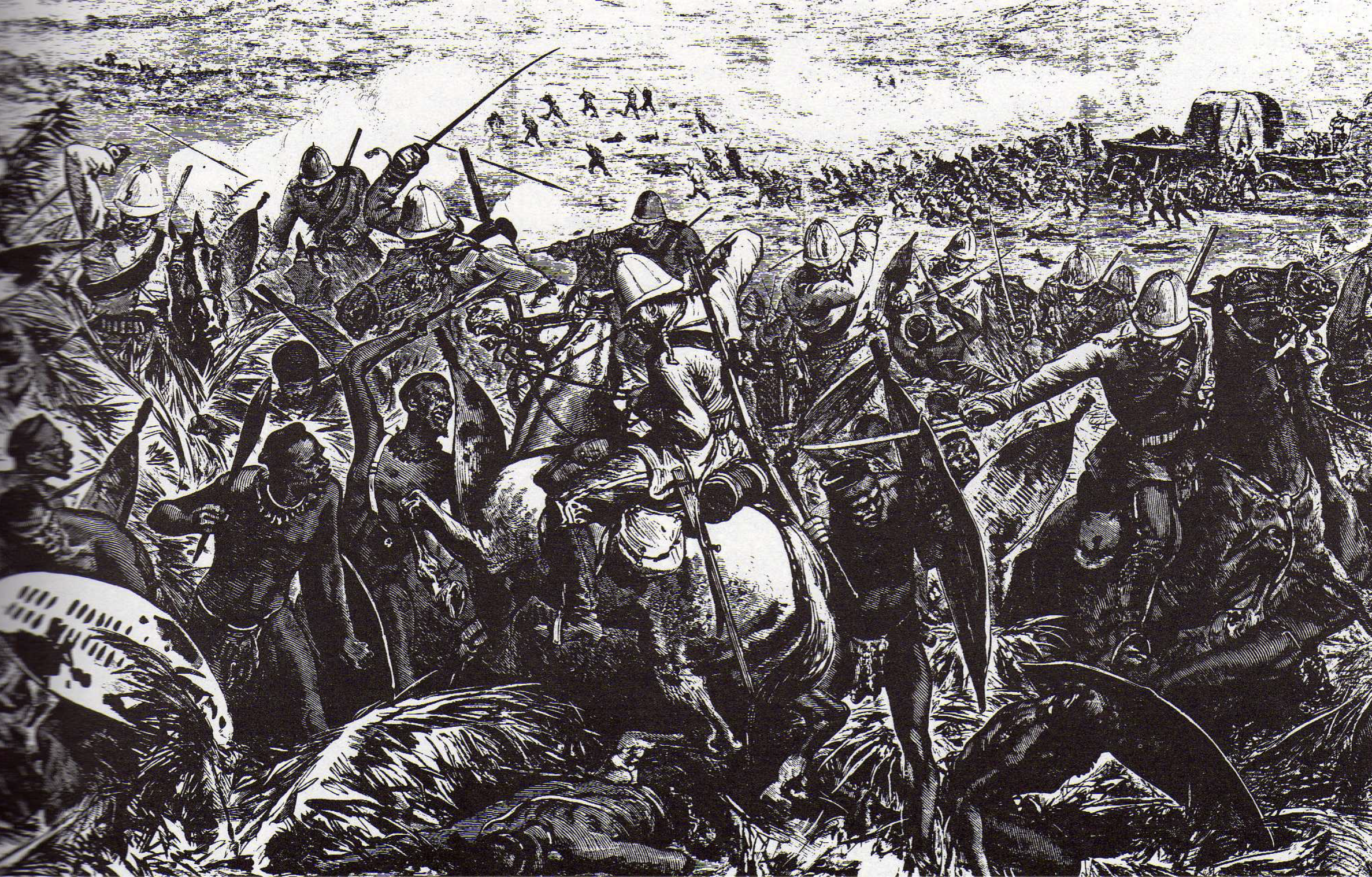
Just as this group of riders crested the second hillock the crowd of Boers opened fire on the advancing British. One of the English officers was killed, along with two other men. Smith was hit but luckily for him the musket ball cut his stirrup leather, bruising his leg. The main Boer position on the western side of the road opened fire as well.
The British wagons shuddered to a halt and Smith returned to the centre of his force to figure out what to do next. The few hundred men of the Cape Mounted Rifles were joined by what Smith called his loyal Boers and the Griqua, and this force thundered off to the left, straight towards Pretorius’ main force lying behind the hills.
Commandant Kock had spotted the wagons, and ordered his men to launch their own attack on the exposed machines, these 150 vehicles stretching back for kilometers to the south. But the Cape Mounted Rifles were ready, and took up positions slowing him down. Then the British cannon opened fire, and Kock’s attack ran out of steam. He’d lost about half a dozen men in the barrage and the firefight by now.
He withdrew westwards, leaving Pretorius to fight off the British near the drift. The Cape Mounted Rifles commanders, particularly lieutenant Warren realised that the critical point of the battle had been reached, and along with two rifle brigades managed to clear Pretorius from the ridge.
The Boers were in a rough spot now, because the British forces had moved so fast, many couldn’t get to their horses behind the hill. They ran over the broken ground towards the large pool of water on the Krommelenboog River.
The rest of the Boers broke and ran, heading towards the Drift which was the easiest place to cross the river. Pretorius managed to rally these men, in the bed of the spruit below the drift. But Smith was not to be denied, and moved a large section of his men to the hill overlooking this position — while the rest of the Boers tried to provide some covering fire for Pretorius from the kraal and the farm house across the river.
The Boers Defeated
At 12.45 the Boers were in full retreat, running up the road to the north, towards their gun position. Their only cannon was knocked out shortly after this. The Boers managed to rally at a few more places as they withdrew, slowing the Griqua and the British soldiers down, buying themselves time.
The Boers were running out of ammunition and by 2pm things were pretty much done. The Boers had been defeated, they rushed to their wagons at their laager 20 kilometers north, then withdrew to Sanna’s Post. From there, Pretorius ordered his men to disperse back to their farms.
The next day, the 30th August 1848, Sir Harry Smith marched to Telpoort, and entered Bloemfontein finally on the 2nd September. He was a happy man. His infantry, and mounted units had worked in perfect harmony with his three 6 pounder guns. They had managed to defeat Pretorius’ veteran frontiersmen in less than a day of fighting. The English had initially thought the Free State campaign against the Boers was going to be bloody and lengthy, but it was over virtually as it started.
The British lost two officers, ten wounded, 14 other soldiers were killed and 32 wounded. The Boers reported they’d lost 9 dead and five wounded, although it is likely they lost far more — possibly as many as 49 men.
And so ended the first of three clashes between the British and the people who would become known as the South African Republicans. Thirty three years would elapse before the next trial of strength between these two opponents.
This battle of Boomplaats is not well known. It was a major victory for the British, and for the Boers, it was a warning about how not to fight against an empire. Pretorius had been stung. More than three decades would elapse before the first Boer War of 1880, and in that war, the Boers were going to teach the British a lesson in military tactics.

Leave a Reply