The series was launched three years ago after conversations with 61 Mech veterans who had suggested I take a look at the Border Wars.

This has been a fulfilling assignment as they say, but also a difficult process. There is very little agreement amongst those involved, the Angolan Army (FAPLA), the South African Defence Force, the Russians and the Cubans. Not to mention the Americans.

Each battle took some time to research, each operation meant toiling away reading source documents and first person accounts.

I’ve found that the SADF reports (those limited to ops and in particular, Savannah), are not accurate in some areas. This has caused rethinking and re-working of some episodes.

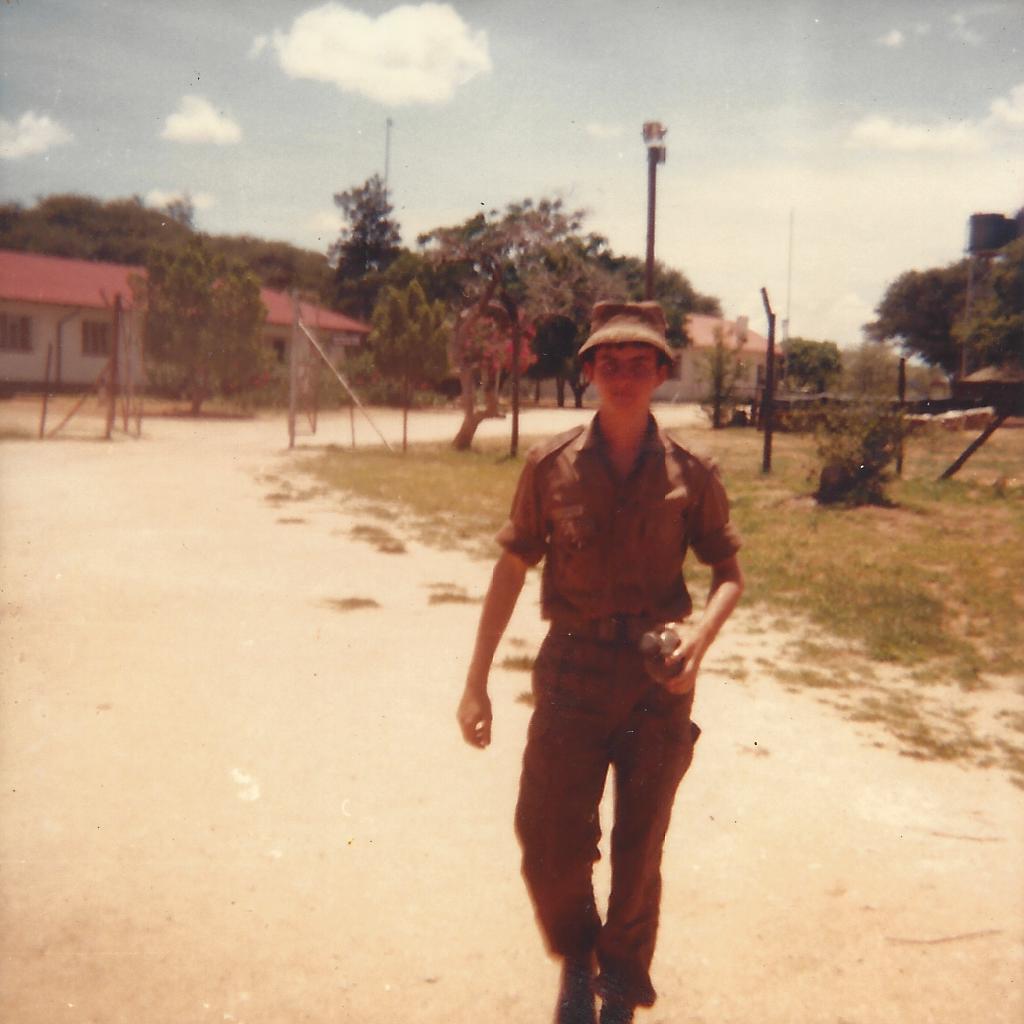
Chris Morrissey one of SA Border Wars listeners and former soldier photographed at Tsintsabis 1980. ©Chris Morrissey.

It’s not over, however. After some prompting I’ve decided to continue with the series on a monthly or bi-monthly basis, depending on the time available. In future there will be more focus on specific operations and more about the covert war.

I was hoping to cover the CCB more extensively particularly what they were up to with the Recces in Mozambique, so this contentious area will be explored fully in future episodes.

For those who’ve sent notes and emails, and for those who’ve donated to the PayPal account which pays all my hosting fees, a big thank you. There are many, the series has passed 540 000 listens!

Some of the listeners have sent comprehensive outlines of their personal role in battles and skirmishes, and this takes a certain amount of guts for the real veterans amongst us.

Thank you for trusting me with your information.

9 responses to “Episode 114 and South African Border Wars podcast winds down”

  1. DES Latham thank you for your Border War series. Having served at the back end of the war it was extremely intro get a view of how it began and unfolded information not always that available at the time Thank you again

  2. Hello Des,
    Thank you so much for all your effort in putting the Border War pod casts together.
    I worked in Rundu with VSO in 1997-2000 and I started the plumbing section in the VTC. I knew about the recent Independence whilst there but had no idea of what really went on. One of the instructors told me, when I was leaving, to get and read Jim Hoopers, Koevoet.
    The only thing I knew, was of South Africa and the Casspirs on the TV, with military and police in conflict with black people.
    As I was taking my family to Namibia in August (which they loved) I thought I had better buy it and read it.
    Along with your podcasts and Koevoet I have learnt a great deal about where I lived for those few years. Most of it starting when I was barely a schoolboy!
    The information is a lot to take in so I have listened to it off and on about three times.
    The road through the Caprivi is tar now so it wasn’t such a bumpy journey from Rundu to Vic Falls. But the reason for the road being so good is all the trucks of copper coming out of Zimbabwe or Zambia and off to Walvis Bay and China.
    The Chinese were building part of the VTC whilst I was working in Rundu, I had no idea of their cunning plans then.
    I am looking forward to listening to more of your podcasts Des.
    Great job.

    1. Hi Rob, thanks for your detailed email! It’s remarkable what we’re finding out as we go in this continuous saga. The political leadership then and now are rife with bias and blind to some of the truths. Like you I have travelled on the Kaza route recently, into Walvis from Zambia, the highway development is remarkable – and a warning to Durban that the copper will likely end up heading off to the West Coast unless things improve for trucks in Southern Africa.

  3. I took part in OPS ASKARI, I was shocked to hear how badly it was managed. Why did senior officers (General Viljoen ) not step in, when it was clear things were being handled so badly. Do very senior officers stay away from such things so as not to have to accept responsibility? With all the previous OPS experience , why was ASKARI so badly managed? I know 2 medics from 5 Medical Bat, were awarded Honaris Crux medals for leaving the converted Ratal ambulance during the first attack on Cuvelai, to retrieve fallen soldiers. Others had already withdrawn from the field of battle.

    Was SA not yet using the G5 artillery at that stage in Angola? I brought home a booklet of anti SA anti Unita propaganda in Cuvelai. I have wondered if a copy of it would be of interest to a SA Border War Historian .

    1. Hi Frank – good question. There appeared to be confusion about whether the South Africans were negotiating or were fighting. There was also haphazard planning and the overall strategy was to drive PLAN/SWAPO out of the towns along with FAPLA. But they didn’t focus on a single target. The SADF underestimated MPLA artillery capacity particularly around Mulondo. Cahama was not taken although it was a prime target. By extending ops into later December the leadership failed to grasp just how exhausted the SADF troops were, and the bad weather and 23mm AA guns and the Soviet tanks were a real threat. Greyling bungled, the others vacillated. The main problem I believe was a lack of a single main target, the SADF plan was too complex. The G5 came along in 1986, three years later.

    2. ps – I would love to see a copy of the booklet!

  4. Francois Erasmus Avatar
    Francois Erasmus

    Good evening Des,Thank you for an amazing podcast — I really enjoyed the content.I served in Quebec Battery from 1987 to 1988.

    We started off at 14 Field in Potchefstroom and did our first tour to Angola with our Bevs from 14 Field. After that, we cleared out of 14 Field and into 4 SAI for our second tour to Angola after some R&R.

    We stayed until we were relieved by the new intake. After another rest period, we returned to Potchefstroom to collect new G5 guns and drove all the way up into SWA, where we were stationed in a stelling between Odandwa and Etali base. During our time there, we never fired a single round from the G5s.

    During our first deployment, we inherited well-used G5s. I was on Charlie gun. On one of our many battery bombardments, Bravo gun had a barrel burst — we were very fortunate that no one was injured.We also experienced a projectile exploding in the chamber of one of the guns. The breech was open, and the explosion ignited some of the charges. Again, we were lucky — no one was near the gun as the crew had received a stand-down command and were back at their rest area.Our own gun ended up with a damaged gearbox and couldn’t lower the barrel. The whole battery was ordered to return to HQ. While driving back, our gun barrel elevated to its maximum position — a hairy experience, but not as bad as the night that followed.That night, we had to move outside the HQ area to find a large V-shaped tree. The tiffies used it to knock the gear loose so the barrel could drop. The recovery truck had all its spotlights on, and everyone was trying to help. In the chaos, no one monitored the radio — we missed the “Victor Victor” warning. Enemy aircraft fired missiles — we’re still unsure if we were the target or just in the wrong place at the wrong time — but fortunately, they missed us by miles. It was the fastest I ever moved in my life. The tiffies managed to kill the lights in record time.

    Good old days…Thanks again for this incredible podcast and for keeping the memories alive.

    Kind regards,Francois

    1. Thanks for listening – and the support Francois! Amazing story, it’s usually later that we realise just how close we are to a deadly situation, at the time it’s over and we move on. The G5 incident is one of those, beyond your control but fate intervened in the timing.

Leave a Reply

Trending

Discover more from Desmond Latham

Subscribe now to keep reading and get access to the full archive.

Continue reading