
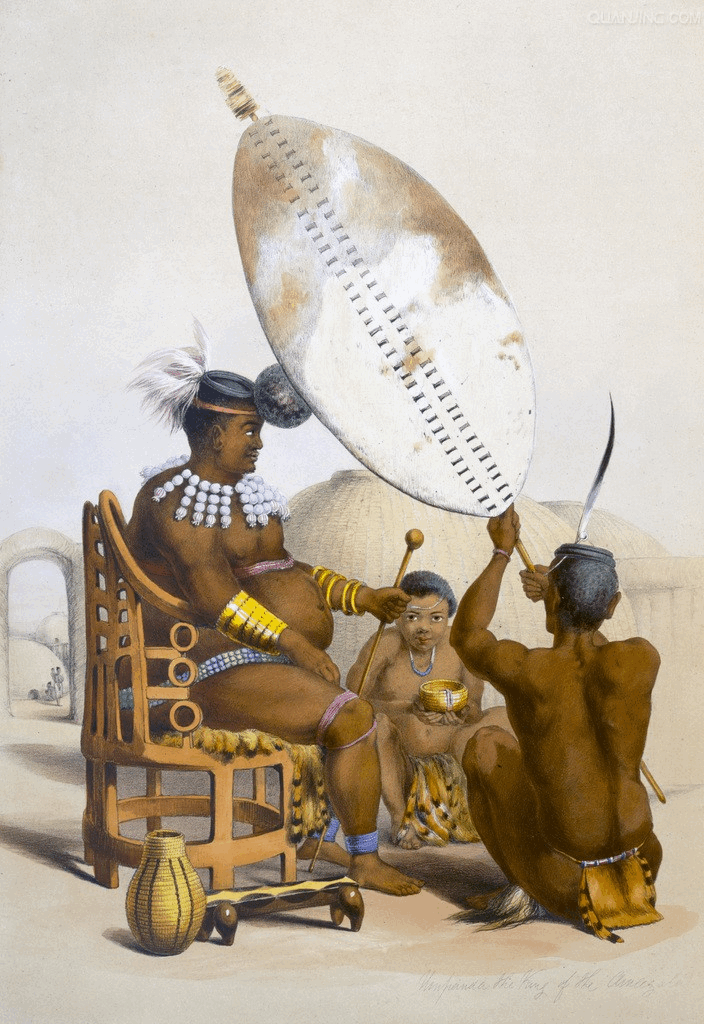
Welcome to our latest blog post on the History of South Africa podcast. In this episode, we dived deep into a turbulent period marked by shifting alliances, clever tactics, and epic battles, focusing on the interactions between the AmaZulu, the amaSwazi, and the Voortrekkers.
Negotiations Amidst Turmoil
The episode opens in 1839, a time of intense negotiations between AmaZulu king Dingana and the Voortrekkers, mediated by British Captain Henry Jervis. Amidst the chaos of regional conflicts, Dingana, desperate to stabilize his reign, proposed an alliance with the British against the Voortrekkers. However, Jervis maintained his neutrality, refusing to take sides.
Peace Talks and Strategic Demands
As peace talks commenced, Voortrekker leader Andries Pretorius put forth a series of demands including the return of stolen livestock and weaponry, and a unique request: that Dingana order his warriors to marry, a strategic move to temper the AmaZulu’s military might.
Dingana’s New Frontier and Swazi Challenge
Dingana, meanwhile, relocated his kingdom northwards, encroaching on Swazi territory. This move not only expanded his realm but also served as a political strategy, giving land to his newly married warriors. However, this expansion brought the AmaZulu into conflict with the amaSwazi, renowned for their martial prowess and led by the formidable Swazi king Sobhuza.
The Swazi Counter and a Widow’s Reign
As the AmaZulu prepared to invade Swazi lands, King Sobhuza, despite being ill, orchestrated a total mobilization to repel the invaders. Tragically, he passed away shortly after, leaving the leadership to Lojiba Simelane, the mother of the young King Mswati II. Under her guidance and the military command of Mngayi Fakudze, the amaSwazi prepared for a critical confrontation.
The Battle: Tactics and Traditions
The ensuing battle near modern-day Eswatini was marked by strategic brilliance and cultural symbolism. The amaSwazi, adopting Zulu military tactics and donning distinctive widow bird feathers, managed to rout the AmaZulu forces. This defeat was a significant blow to Dingana, coming on the heels of his earlier defeat by the Boers.
Dingana’s Waning Power and Mpande’s Exodus
As Dingana’s power waned, his half-brother Mpande seized the moment. Fleeing Zululand with thousands of followers, Mpande sought alliances with the Boers, further weakening Dingana’s position. His departure symbolized a critical juncture in Zulu history, as Mpande’s diplomatic acumen became increasingly evident.
The Boers, the British, and Shifting Allegiances
The dynamics between the British, the Boers, and the Zulu factions continued to evolve. The Boers, under Pretorius, grew increasingly assertive, demanding reparations from Dingana. Meanwhile, the British, led by Captain Jervis, struggled to maintain their influence in the region. The departure of the British garrison from Natal marked a significant shift, leaving the Boers and Mpande to plan their joint campaign against Dingana.
Looking Ahead
This episode highlights the complex interplay of politics, culture, and warfare in 19th-century South Africa. As we delve deeper into this fascinating period, stay tuned for our next episode, where we will explore the aftermath of these tumultuous events.
(Blog post image By Unknown author – THE KINGS OF THE ZULU, Public Domain, https://commons.wikimedia.org/w/index.php?curid=3611894
Hi James, thank you for listening and finding value in the podcast. Stalingrad is ever present in the minds of…
I just wanted to take a moment to thank you profusely for your podcast series on Stalingrad. I first listened…
Fantastic comment Jono, lovely to meet you! I remember your family well, and see Jackie these days. I’ll email more…
Hello Mr Latham, Thank you very much for all your work around this podcast. I am well and truly addicted,…
Hi Des I’m a great fan of your podcast ‘The history of South Africa. I love reading SA history and…



Leave a Reply