
The Springboks beat the All blacks in the second test a nail-biter at Cape Town (score 33-26), leveling the series, and it got me thinking about the history of rugby in South Africa.
This is the first full-blown tour undertaken by the All Blacks of South Africa since 1997, almost three decades ago. That is well into a generation later and what was amazing to see was the number of kids squeezed into DHL Stadium, some with placards that read “Future Springbok” and an arrow pointing at the hopeful lad.
The first game of rugby took place next door to where the new DHL Stadium stands, on the fields of Greenpoint, in August 1862 where the Army took on the Civil Service. White Britishers and Afrikaners played — no blacks, let alone All Blacks. That didn’t last too long, by the 1890s black South Africans had begun to play the sport but were kept at arms length of the white game.
In 1899 the Whites-only South African Rugby Board was founded, the South African Coloured Rugby Football Board was launched in 1905.
The first rugby team was Hamilton Rugby Football Club formed at Sea Point on 14 March 1875, which turned 150 in 2025.

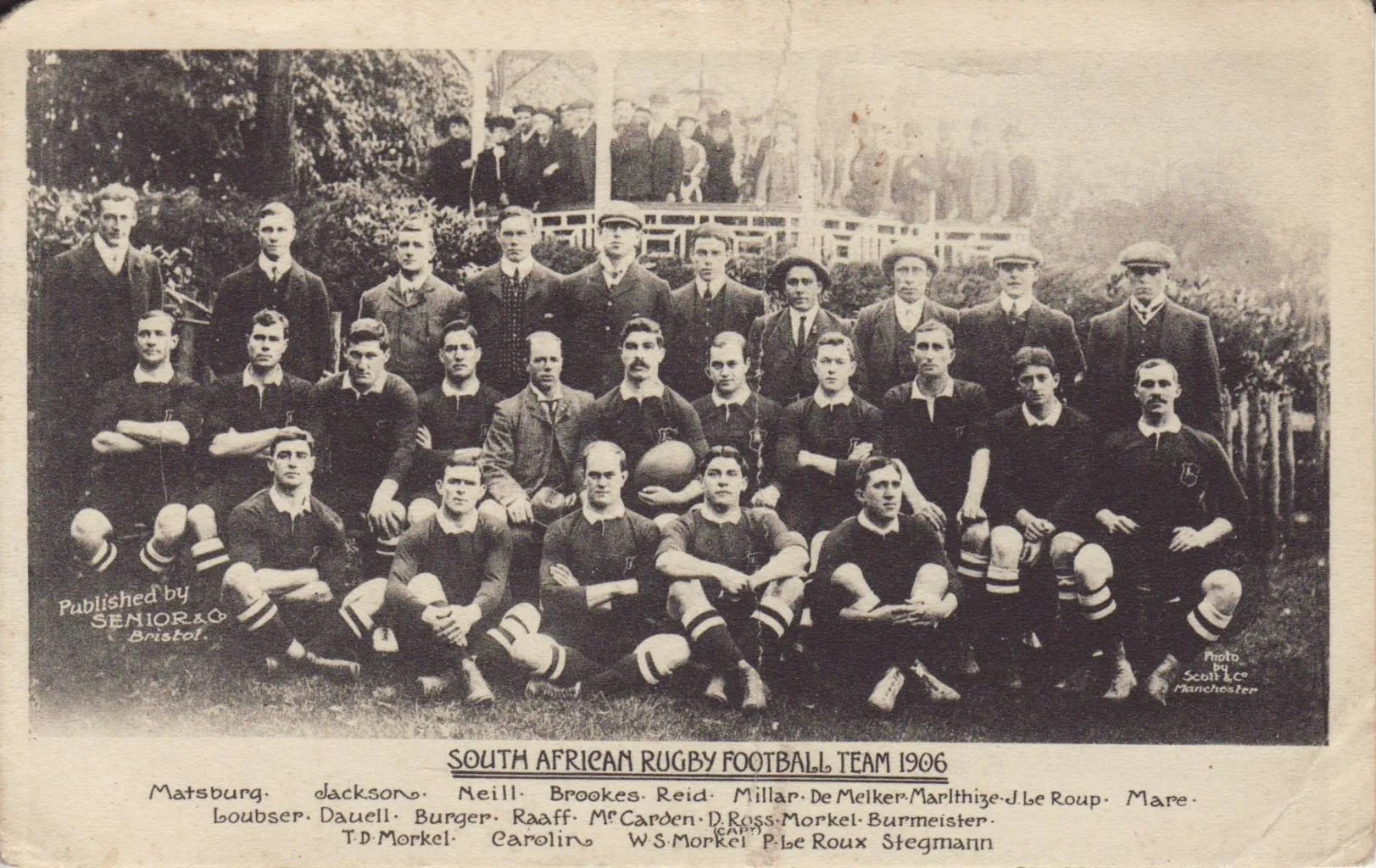
The first international tour undertaken by the South Africans was in 1906 to the British Isles, and the team combined Afrikaans and English-speakers in an attempt at harmony after the Anglo-Boer War shattered South Africa.
It was also the first time the term “Springboks” was used when the British who came up with the Anglicized name– a version of the team’s Dutch name, Die Springbokken.

The Honour Code
Rugby is a game that seems tailor made for South Africans of all types, and genders. The rough and tumble attracts men, women and children, and early games often took place between church groups, particularly when it came to the game development amongst black South Africans. It rapidly took on a community edge, with raffles and hall dances improving relationships between people who would otherwise have been rather stand-offish.
Because it is a tough sport, rugby increased a sense of mutual respect. Once you play the game and realise that the man (or woman) opposite you is brave, the colour of their skin and their religion fades in relevance. A bruising tackle is a bruising tackle and a brilliant side-step a brilliant side-step.
The 20th Century is full of the exploits of famous boks. (Please note, these are only from the 20th Century, not the 21st).

Paul Roos: The captain of the historic 1906–07 tour to Great Britain.

Bennie Osler: The defining flyhalf of the 1920s and 30s. Known for his tactical kicking, ruthless game management, and leading the Boks to a grand slam tour in 1931–32.

Boy Louw: A cornerstone of the legendary 1937 team that won a series in New Zealand—the first team to ever accomplish that feat on Kiwi soil.

Gerry Brand: A brilliant fullback and goal-kicker from the 1930s, revered for his immense positional play and booming drop-kicks.

Danie Craven: One of the most influential figures in rugby history—a world-class scrumhalf in the 1930s who developed the famous dive-pass, later becoming national coach and administrator.

Hennie Muller: Known as “Windhond,” he was an exceptionally fast, destructive eighthman who led the 1951–52 touring side across Western Europe.

Frik du Preez: Named South Africa’s player of the 20th century. A lock/flanker who possessed rare athletic ability—capable of kicking drops, place-kicks, and sprinting down the wing.

Mannetjies Roux: A hard-tackling, unpredictable center/wing during the 1960s who became a iconic folk figure in South African rugby lore.

Jan Ellis: A relentless, tireless flanker who won 38 caps during an era of sparse international fixtures, setting a long-standing national record.

Danie Gerber: Widely considered one of the greatest outside centers to play the game. Possessed explosive speed, strength, and a side-step that tore international backlines apart despite limited tests.

Schalk Burger Sr.: A formidable lock and physical presence in the late 1970s and 80s forward packs.

Ray Mordt: A powerhouse wing who scored a legendary hat-trick of tries against the All Blacks in Auckland during the tumultuous 1981 tour.

Morné du Plessis: During the five years from 1975 to 1980 that he served as captain, the Springboks won 13 of 15 matches, giving Du Plessis an 86.66% success rate as captain.

Francois Pienaar: The inspirational flanker who captained the Springboks to the emotional 1995 Rugby World Cup title on home soil.

Joost van der Westhuizen: A physically imposing, aggressive scrumhalf who revolutionized the position with his running game and try-scoring ability.

Os du Randt: One of the greatest loosehead props in rugby history, acting as a crucial anchor for both the 1995 and 2007 World Cup-winning packs.

Chester Williams: The electric wing who became a defining symbol and star performer of the 1995 World Cup campaign.
Apologies if there are players you believe should be on this list, it is not supposed to be definitive!
Desegregation and the coming of Bok Superpowers
By the 1980s this segregation was breaking down, one of my best friends of the era, Charles, an Afrikaner, played for predominantly black teams. As a 6.4″ lock, he was tough and needed to be as opposition players lined up to ruck him at will. But Charles wasn’t a ninny, and those who sought to test his mettle were forced to accept that he was first and foremost, courageous. A couple of beers in the bar later and stories exchanged, friendships were forged.
My time coaching women’s rugby at Stanford, California
When I was fortunate enough to land a Reuters sponsorship to Stanford University in Palo Alto, California, as a Knight Fellow in 1993/4, I ended up training the Stanford Women’s Rugby Team for that year. There was such an interest amongst women there that we had two teams, and no problem signing up new players. One of the most famous previous players was astronaut Sally Ride who played as part of the founding team of 1977.
I was in awe and still am of the professional approach these Ivy League women took to a game that can disable you in a split second. In my team, the full-back cracked her scapula, and one of the forwards broke her ankle. In one instance, the hooker’s father, a Japanese-American ran on the field to grab his daughter he was so shocked at the violence he witnessed.
It didn’t help that the position was called ‘hooker’ and she asked me later if she could change the name to central front rower which we agreed was a more neutral term.

The Stanford Women’s Rugby Team practiced next door to the Stanford mens Football team, who would wonder over and watch with open mouths as the women flattened each other during practice.

History of South Africa update
Enough said, this newsletter is not about rugby, its about the History of South Africa podcast (mainly). We are up to 1888 in the series, and Cecil John Rhodes is about to launch his British South Africa Company northwards while gold mining is bringing millions of pounds into the Transvaal.
A seminal period in South African history. But if you’ve missed the latest updates, this is a summary of episodes 279-290.
Lord De Villiers is beginning to make a name for himself in judicial circles, Zibhebhu’s Mandlakazi shattered Cetshwayo’s uSuthu and set off a Zulu civil war, following which the Boers anointed Dinizulu as king, but not before Cetshwayo died suspiciously. Poisoned most likely.

There is an episode covering the scramble for Africa which kicked off formally in 1884, then we hear about Lieutenant Colonel Charles Warren’s Great north road telegraph building escapade, where he hired the very Boers he was sent to fight to help with his logistics. An embarrassing moment.
Gold is discovered on the Witwatersrand, its secret given away over a bottle of mampoer, while Episode 287 deals with the early days of divvying up the various farms around a new town that was named Johannesburg.
The scene shifts in Episode 288 to the Sultan of Zanzibar who is double-crossed by the British who do a deal with the Germans, then in Episode 289 we’re back drinking Black Velvet with Rhodes in Kimberley as he secures the diamond fields for De Beers.

Episode 290 is all about the strange differences and many similarities between Africanders who are English speaking black and coloured men, and Afrikaners, formerly Dutch. Voters are disenfranchised in the Cape as conservatives take control of parliament.
Coming next, more about the railroads and Paul Kruger’s dream of a line to Delagoa Bay.


Leave a Reply