
The fuse is lit
Episodes 247 to 249 move us from political manoeuvring to the first physical steps of invasion. What looks, at first glance, like “frontier friction” is revealed as something far more deliberate: a war engineered through a mix of opportunism, ideological certainty, and bureaucratic sleight of hand.
At the centre of it all are two men: Sir Theophilus Shepstone, once a key diplomatic link to the Zulu court, and Sir Bartle Frere, a High Commissioner pursuing confederation and convinced Cetshwayo must be broken. Against them stands King Cetshwayo kaMpande, trying (often painfully) to avoid war while managing internal pressures, border instability, and a rapidly changing military world.

stephen@britishempire.co.uk
http://www.britishempire.co.uk/
Episode 247 — A Ball of Sand Fallacy and Frere Demonises Cetshwayo
Shepstone’s turn at Conference Hill
In October 1877, Shepstone meets a Zulu deputation west of the Ncome/Blood River at a flat-topped rise that becomes known as Conference Hill. The Zulu are led by Mnyamana kaNgqengelele (Buthelezi), with senior figures present including Bhejane, the king’s personal attendant (inceku), and Sigcwelegcwele of the iNgobamakhosi.

The shock is immediate: Shepstone reverses his long-standing position and pushes the Zulu to concede disputed land to the Transvaal Boers. The Zulu response is scathing and personal. Sigcwelegcwele frames it as a betrayal of friendship with Mpande’s son:
- If a father dies and leaves a son, should the father’s friend be harsh to the son?
When Shepstone patronises the deputation (“Go and tell my child…”), Bhejane delivers the line that lands like a hammer:
“Somtseu, we do not understand you.”
Shepstone erupts when addressed by name rather than title, and the meeting collapses. Mnyamana strikes his shield with his assegai and walks out, followed by the delegation. In Zulu oral tradition, this episode is remembered as a moment that signals war’s approach.

Frere’s appetite for conflict
Shepstone’s bruised ego turns into political ammunition. He convinces Frere that Cetshwayo is not merely difficult but strategically dangerous, even hinting at a regional anti-white coalition (dragging Sekhukhune into the narrative as a supposed subordinate of Cetshwayo).
At the same time, important context sits in the background: Shepstone and Cetshwayo had cooperated closely since 1873, including agreements over migrant labour routes and fees/taxes that brought Cetshwayo substantial revenue. Cetshwayo needed cash, partly because a catastrophic outbreak of lung-sickness had devastated royal herds after his enormous coronation cattle displays.
Guns in Zululand, but not used as you’d expect
Firearms have spread fast. By mid-1878 you describe roughly 20,000 firearms in Zululand, aided by smugglers like John Dunn. Yet Cetshwayo tends to hoard firearms as symbols of authority rather than distribute them systematically across the amabutho. That decision will matter later.

The Boundary Commission and Frere’s cover-up
Cetshwayo turns to Natal’s lieutenant-governor Sir Henry Bulwer, who appoints a Boundary Commission. Both Cetshwayo and Frere publicly endorse it — for opposite reasons.
When the Commission reports in July 1878, it concludes the Boers have no right to the disputed territory in Zululand. Bulwer signals that peace with the Zulu is entirely feasible. Frere’s reaction is decisive:
he suppresses the report for five months while continuing war preparations.

A pretext arrives: Sihayo’s sons and the Natal crossing
In late July 1878, Mehlokazulu, son of the forceful chief Sihayo, crosses into Natal to seize two of Sihayo’s wives who have fled. They are dragged back over the border and killed on Zulu soil. The British demand Mehlokazulu be surrendered for trial in Natal. Cetshwayo refuses, despite senior advisers urging him to hand the men over because they have broken rules and given the British an opening.
Chelmsford nods as Frere escalates
By August 1878, Lt Gen Sir Frederic Thesiger establishes headquarters at Pietermaritzburg (soon to become Lord Chelmsford). Cetshwayo writes directly to Frere asking what he has done to deserve encirclement.
In London, Sir Michael Hicks Beach grows alarmed and urges caution, but Frere withholds crucial information and pushes ahead.

The ultimatum: designed to be rejected
In December 1878, the Boundary Commission’s finding is finally revealed — and immediately weaponised. John Shepstone (Theophilus’s brother) delivers an ultimatum demanding fines, surrenders, and, most explosively, the dismantling of the Zulu military system within 30 days. Expiry: 11 January 1879. After that: invasion.
John Dunn breaks
Accused inside Zululand of betrayal during negotiations, gunrunner and translator John Dunn panics and throws in his lot with the British. On 31 December 1878, his family and cattle begin moving into Natal.
The “ball of sand” idea
Shepstone assures Frere that the Zulu kingdom is fragile:
“The kingdom is like a huge ball of sand…”
Frere embraces the fantasy: one sharp kick and the whole system collapses. The problem, as your episode makes plain, is that this misreads what motivates ordinary Zulu men: not devotion to Cetshwayo alone, but fear of losing land, cattle, and family under British rule.
Listen to the episode here
Episode 248 — The Eagle and the Four Hawks: The Making of an Inevitable War

The Disputed Territory: where all claims collide
The borderlands around Phongola, Ntombe, Mkhondo become the pressure point: Boers, Swazi, and Zulu all claim access and authority. The Zulu seasonal cattle movements and the region’s agricultural value make it strategically and economically central.
The Border Commission has already confirmed Zulu rights — but Shepstone wants to placate Boers in the annexed Transvaal, and Frere wants confederation. Cetshwayo and Sekhukhune are framed as obstacles.
Militarised societies and the trap of “honour”
You widen the lens here, comparing the Zulu military-marriage system to other martial cultures (Maasai, Sparta, Aztecs, Mongols) to make a tactical point: honour systems can become liabilities when technology and warfare change.
By 1878, Zululand has firearms, but the tactical culture still privileges closing distance and “washing the spear”. You underline the coming problem: many warriors will fire once, drop the gun, and charge — brave, disciplined, and often disastrous against modern firepower.

Border incidents pile up
The ultimatum’s “reasons” expand beyond the July crossing. Tensions are inflamed by:
- British surveyors detained and released
- settlers’ outrage
- threats against German-speaking settlers at Hermannsburg Mission Station
- and the violent instability of the north, including the Swazi prince-bandit Mbilini kaMswati, raiding in the Phongola caves with Cetshwayo’s tacit indulgence
An omen at oNdini
Zulu oral tradition supplies a bleak sign: an eagle above oNdini set upon by four hawks — interpreted by izangoma as the four neighbouring states combining to destroy the Zulu kingdom.
The ultimatum meeting: theatre, not negotiation
On 11 December 1878, Zulu delegates cross to Natal near the Thukela and meet under an awning by a fig tree, watched from Fort Pearson. But the men present are not Cetshwayo’s key inner council figures — not empowered to concede what the British demand.
The ultimatum is, effectively, a locked door presented as diplomacy.
Mustering at kwaNondwengu and war-doctoring
As January approaches, Cetshwayo calls regiments to gather on the Mahlabathini plain, in war dress, carrying guns and ammunition. The timing intersects with the first-fruits season (uKhosi/Ukhozi), and the practical pressure of late rains and unfinished planting.

Instead of ceremony, there are war rituals: muthi, doctoring, sacrifices in the eMakhosini valley, consultation with ancestors, and a growing certainty among younger amabutho that the moment has arrived.
Cetshwayo asks for time, Bulwer refuses
On 11 January 1879, Cetshwayo requests more time until harvest. Bulwer’s reply is blunt: deal with Chelmsford, who is entering with his army.
Chelmsford’s force and his temperament
You sketch Chelmsford as courteous and composed, but also rigid, indecisive in delegation, and prone to formulaic tactics. He plans a five-column invasion of around 18,000, including British regulars, colonials, and large numbers of Natal black auxiliaries — though Bulwer initially resists fully arming and expanding these forces.
Listen to the episode here
Episode 249 — Three Columns and a Thousand Secrets: Chelmsford’s 1879 Invasion of Zululand
The invasion begins: slow power, vast logistics
Chelmsford’s army does not move like a blade; it moves like a machine. You give the numbers that make the point:
- 10,023 oxen
- 398 mules
- 977 wagons and 56 carts

The plan assumes roughly 20 km a day. In mud and rain, the columns will often manage closer to 10 km a day — and that slow pace creates vulnerability.
Three columns, not five
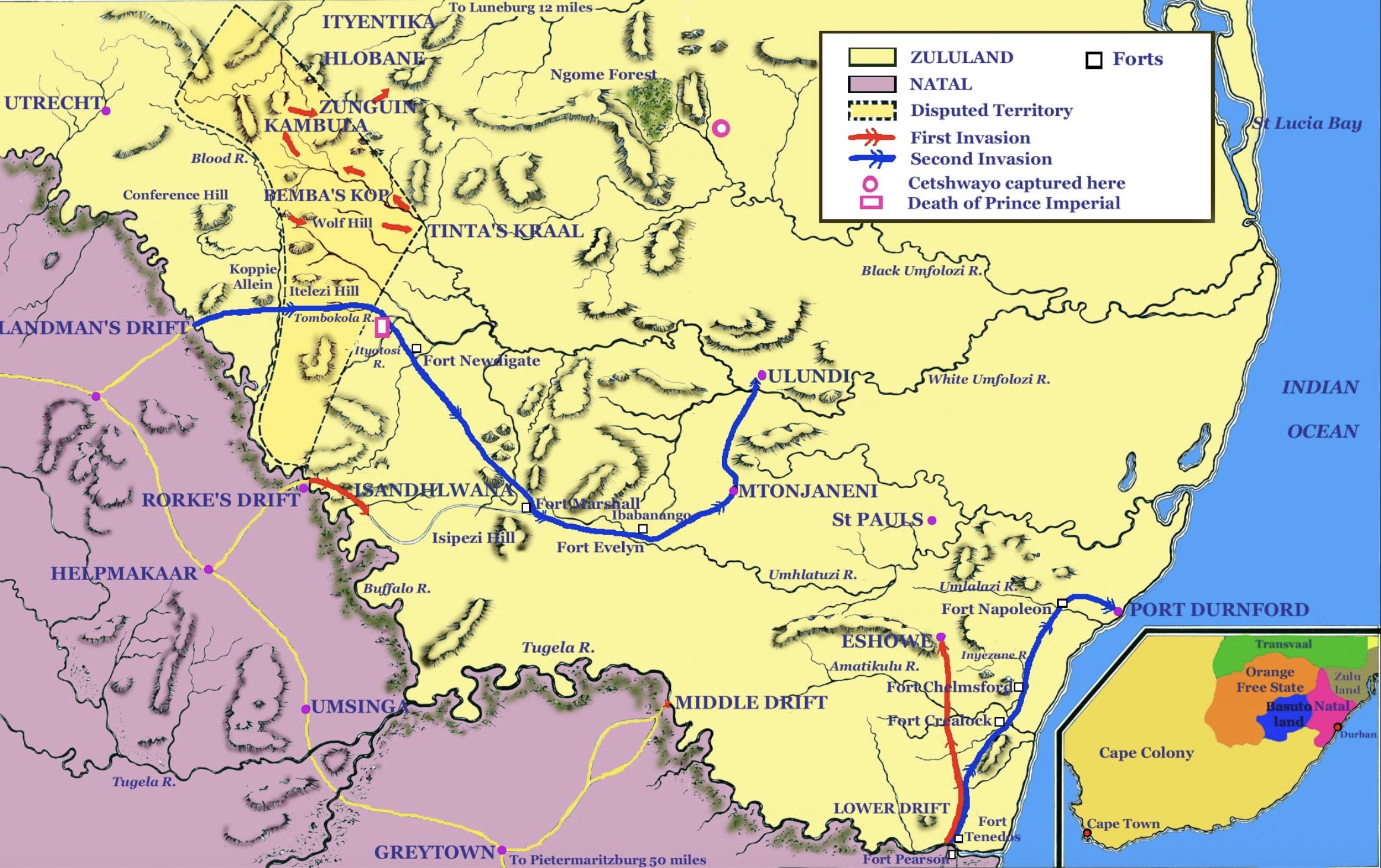
Chelmsford reduces from five columns to three, largely because of shortages in transport and officers. The invasion routes are chosen partly to guard Natal from counter-incursion:
- across the lower Thukela and up towards Eshowe
- across Rorke’s Drift towards oNdini
- from the Transvaal across the Ncome/Blood River region
The goal is convergence on oNdini/Ulundi — with scorched-earth logic: burn homesteads, seize grain and cattle, starve the amabutho.
Boer advice ignored: laagering
Boers and settlers urge Chelmsford to laager wagons in a defensive circle inside enemy territory. Chelmsford dismisses the advice as too slow and cumbersome. You underline the grim irony: he will adopt laagering later — but only after it is too late for many.
British firepower versus Zulu intelligence
You provide a hard comparison: British matériel is formidable (Martini-Henry rifles, artillery, rockets, Gatling gun), but their critical weakness is intelligence.
Zulu intelligence, by contrast, is described as fast, detailed, and pervasive — spies across Natal, the Transvaal, Delagoa Bay, and even inside British columns as servants. Cetshwayo receives daily reports: troop numbers, guns, commanders, direction of movement, even personalities.
Cetshwayo mobilises about 29,000 warriors and plans to strike the strongest British formation first: the central column.
11 January 1879: crossing at Rorke’s Drift
At about 2 am, bugles sound reveille under a full moon. Lt Col Richard Glyn’s No. 3 Column crosses the Mzinyathi/Buffalo River at Rorke’s Drift. Glyn is portrayed as hard-edged, experienced, and temperamentally brittle — a product of the India campaigns and the purchase-system of commissions.
The details of adaptation matter: faded tunics, helmet plates removed, helmets dyed brown, some adopting wide-brimmed hats — men learning to survive in a landscape that punishes visibility.

The Natal Native Contingent and Pioneers
You lay out the structure and prejudice embedded in it:
- Natal Native Contingent (NNC) recruited in large numbers
- only about one in ten issued rifles (often outdated Sniders or older Enfields)
- most carrying assegais and shields, marked by red bandanas
- Natal Native Pioneers, Durnford’s concept, armed but also carrying picks and shovels for roads and earthworks
Bulwer refuses to arm all African auxiliaries fully — a decision that will echo through the campaign.

The war’s first invader: a journalist
In a wonderfully sharp moment, you note the first man to enter Zululand after war is declared is not a soldier but Charles Noggs Norris-Newman, correspondent for the London Standard — a reminder of how effectively Frere concealed the scale of his intended war from the British press.

“Where is the enemy?”
Once across, the land looks deceptively open: rolling green hills, a solitary herdsman, cattle seized. But scouting patrols hear war songs and find nothing. The Zulu presence is felt more than seen — “melted away like the mist”. Chelmsford grows uneasy: the depot near the river is vulnerable if he pushes forward without contact, and politically he needs evidence of “Zulu aggression” to justify Frere’s narrative.
He orders the column ready to march at dawn to locate the warriors believed to be nearby.
Listen to the episode here
Where this leaves us
By the end of Episode 249, the war is no longer a prospect. It is a marching column, a river crossing, a seized herd, a vanished enemy, and a commander trying to force early contact before his own logistics become his trap.
The tragedy, already visible, is that Frere and Shepstone mistake Zulu cohesion for fragility, and British modernity for inevitability. The Zulu, meanwhile, understand the invasion in deeply personal terms: land, cattle, family, freedom — and that kind of motivation does not behave like a “ball of sand”.
Episode 250 — Nqutu’s Rocky Mountains: British officers bicker before Zulu snipers target an entomologist hunting beetles
A quick milestone — and then straight back to the edge
By mid-January 1879, Chelmsford’s central column is inside Zululand after crossing at Rorke’s Drift. The numbers matter because they reveal what kind of creature this army is: roughly 4,700 troops and support, dragging 220 wagons, 2,000 oxen, plus carts and mules — a moving town that takes over an hour to pass a single point. Cetshwayo has already decided: this is the column that must be hit hardest.

Officers at war — with one another
The first danger in this episode isn’t Zulu marksmanship. It’s imperial hierarchy.
Lieutenant Colonel Richard Glyn is the column commander in theory — experienced, invested in “his” regiment, and proud. But Chelmsford arrives at Helpmekaar and effectively takes over, and the relationship sours instantly. Chelmsford’s micromanagement pushes Glyn into the humiliating role of camp supervisor: guards, inspections, routine order — an “inflated sergeant major” while the real decisions are made elsewhere, behind closed tent flaps.
Then come the poisonous staff dynamics:
- Major Cornelius Francis Clery (Glyn’s staff officer) — vindictive, gossipy, already seasoned by the Pedi campaign.
- Lt Col John North Crealock (Chelmsford’s military secretary) — waspish and unpleasant, but with the incongruous Victorian flourish of being a talented watercolourist.
Both write to Major General Sir Archibald Alison in London, and both undermine the other camp. Crealock’s contempt is explicit: Glyn is “regimental” and limited. Clery, in turn, complains that Crealock is overreaching, and drops a detail that will later matter: Chelmsford personally directs patrols and reconnaissance.

So the invasion begins not with clarity of command, but with memos, grievance, and ambition — the sort of internal friction that makes every external threat sharper.
Leave a Reply