Episodes 232–235: Diamonds, Diggers, and Dual Coronations
Episode 232
Diamond Geology as an Art, Dinosaur Veldskoene & Waterboer’s Claim
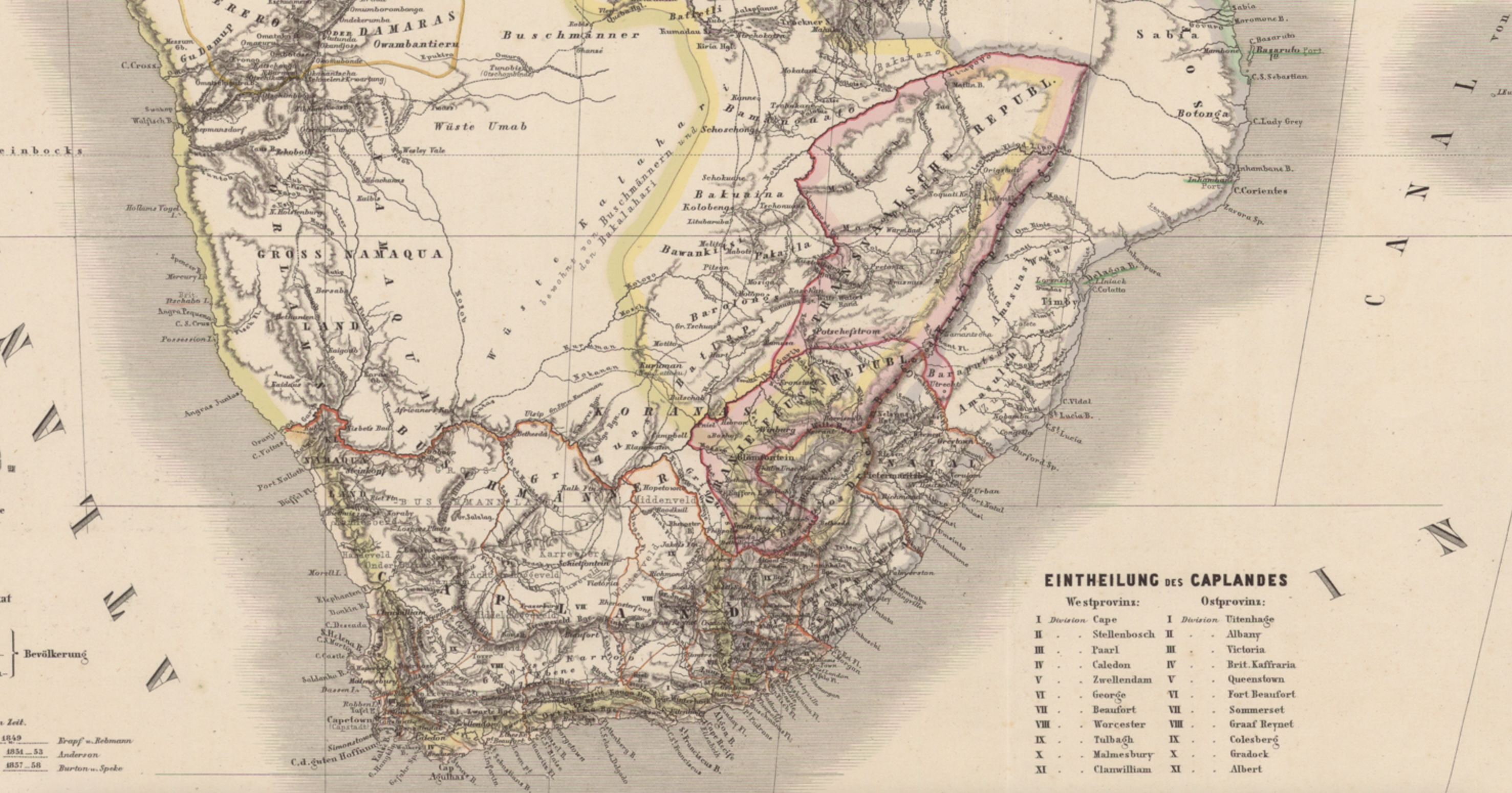
By 1870 the Vaal’s banks were alive with dust, tents and ambition. What began with a thousand diggers swelled tenfold by year’s end. Klipdrift (later Barkly West) was the magnet, its river diggings stretching forty kilometres.
Chief Jantjie Mothibi of the Tlhaping watched as diamonds once brought to him in tribute were snapped up by a global flood of prospectors. Port Elizabeth merchants, with their inland agent networks, bought up farms like Bultfontein and clashed with squatters.
“There were real diamonds under the soles of their veldskoene and extra-strong boots.”
Geology itself quickened. Emil Cohen pointed to volcanic pipes, Edward Dunn counter-claimed, and the Cape Monthly printed the vitriol. A Khoekhoe driver cracked that the Karoo’s fossil footprints proved Adam wore veldskoene — and Massospondylus obliged with broad, blunt toes pressed into rock.
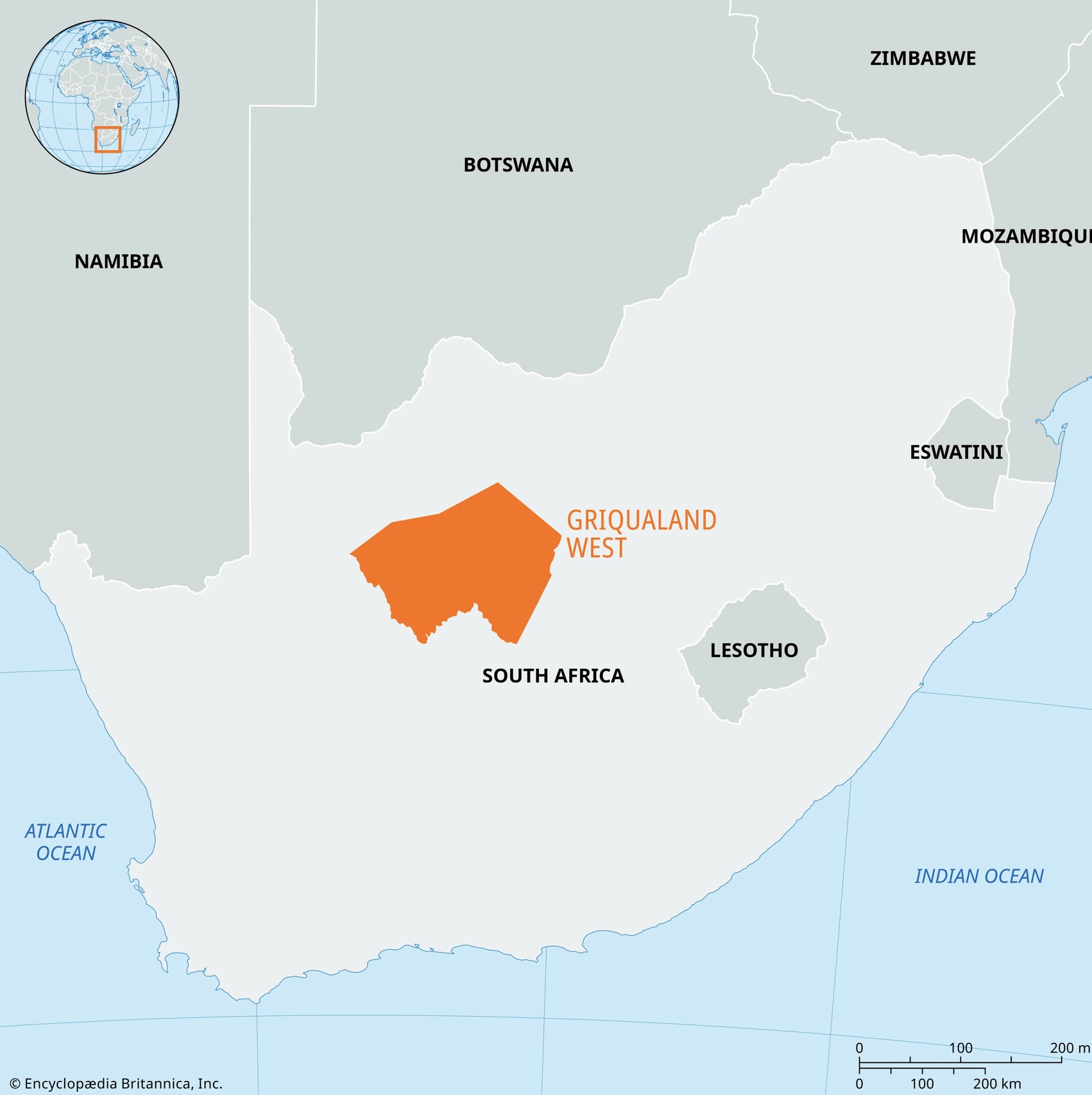
Meanwhile, Nicholas Waterboer insisted the diamondiferous land was Griqua. The Free State and Transvaal disagreed. Flags would soon be hoisted, and torn down.
Episode 233
Stafford Parker’s Diggers’ Republic & the Birth of FNB
In 1870 a former artist and sailor, Stafford Parker, declared himself president of the Diggers’ Republic at Klipdrift. He drilled his Mutual Protection Association with fiddle, concertina and cracked drum, while the salutes were — naturally — irregular musket fire.
Parker’s corrugated-iron Music Hall doubled as canteen, assembly hall and church. By day he dispensed discipline; by night he poured drinks.
When High Commissioner Barkly annexed Griqualand West in 1871, Free State President Brand was incandescent. Only in 1876 did Lord Carnarvon settle matters, paying £90 000 compensation.
That sum seeded the National Bank of the Orange Free State — which through mergers became the National Bank of South Africa, folded into Barclays DCO, and eventually emerged in the 1980s as First National Bank (FNB).
If you bank with FNB, your account carries a faint trace of Parker’s irregular musket salute.
Parker himself rode north, ending as “Ex-President” in Barberton, whiskers intact.
Episode 234
This was the first fully-automatic calculating machine. British computing pioneer Charles Babbage (1791-1871) first conceived the idea of an advanced calculating machine to calculate and print mathematical tables in 1812. This machine, conceived by Babbage in 1834, was designed to evaluate any mathematical formula and to have even higher powers of analysis than his original Difference engine of the 1820s. Only part of the machine was completed before his death in 1871. This is a portion of the mill with a printing mechanism. Babbage was also a reformer, mathematician, philosopher, inventor and political economist.
Babbage’s Final Calculation, Cape Self-Rule & the End of Mpande’s Reign
Globally, 1871–72 was seismic: Germany unified, the Paris Commune rose and fell, Chicago burned, and Charles Babbage died with his brass “analytical engine” still only half-built.
At the Cape, by a single vote, responsible government was adopted. John Molteno became the first Prime Minister, installing a cabinet of English speakers despite a Dutch-speaking majority. Cape politics lurched toward self-rule; the franchise still open to landowning black voters.
Meanwhile in Zululand, King Mpande kaSenzangakhona died. His ox-skin shroud, the “boot-shaped” grave, the spears sunk in the Ntukwini River — all observed with ritual precision. His counsellor Masiphula presided; his son Cetshwayo manoeuvred.
Two constitutional experiments — Cape self-rule and Zulu continuity — were set on a collision course.
Cetshwayo did not wait for Britain’s imprimatur. He staged a full Zulu coronation: the Great Hunt (ihlambo), sacrifices at emaKheni, and a gathering in the sacred valleys of Zululand.
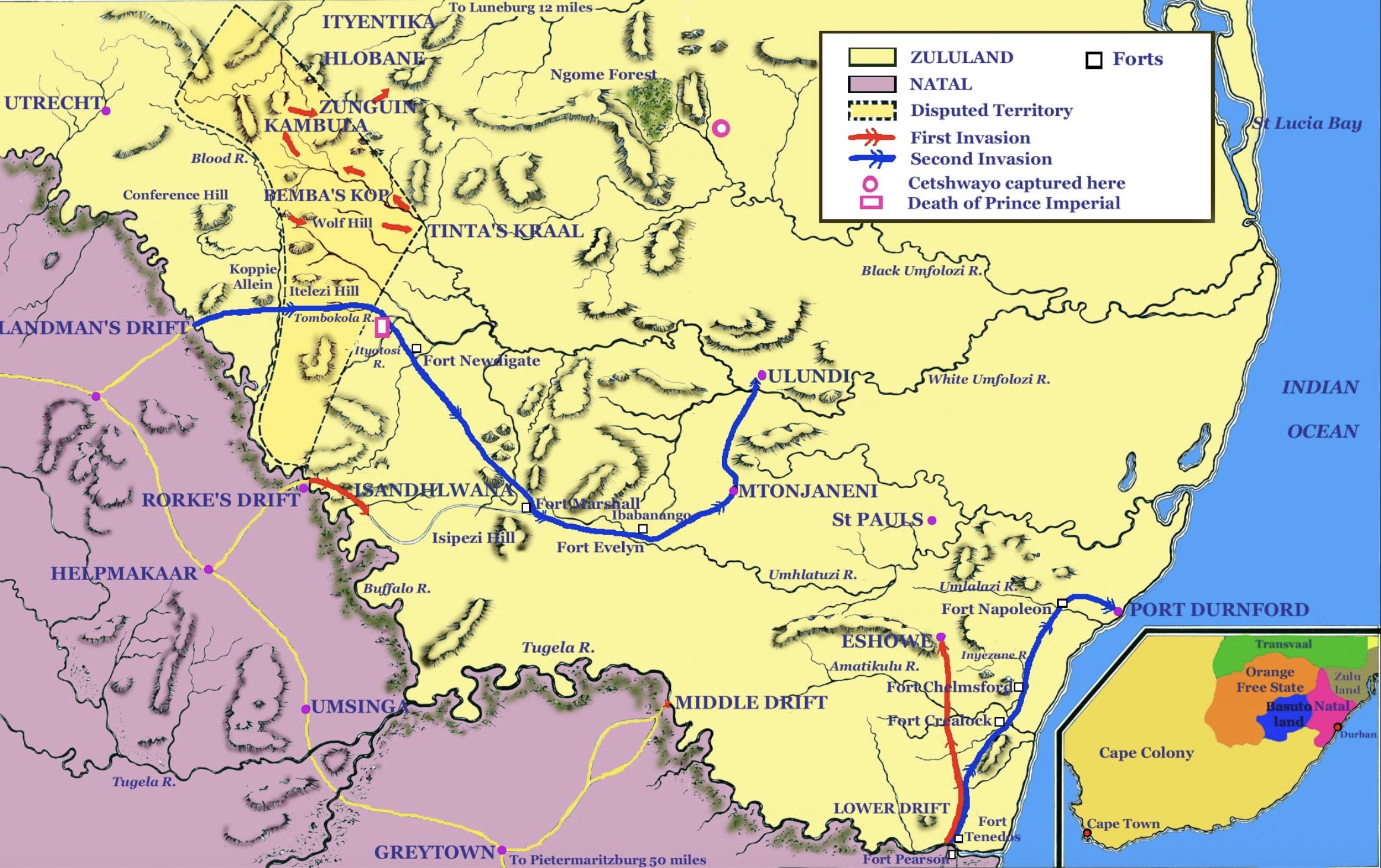
British Military Map of Zululand 1870.
He travelled in John Dunn’s trap, glamping 1873-style. His isigodlo followed; muskets cracked in volleys to impress doubting northern chiefs. Zibhebhu of the Mandlakazi swaggered in, Hamu yielded, and Cetshwayo was acclaimed king.
Then came Masiphula’s end. Oral tradition says poison was slipped into his beer gourd. The old adviser drank, trembled, and died.
Days later Theophilus Shepstone finally arrived, made to wait before erecting his marquee. On 1 September 1873 he crowned Cetshwayo again — this time “in the name of Queen Victoria”. A brass band burped, guns fired a seventeen-shot salute, and a photograph was taken: Cetshwayo in scarlet and feathers, surrounded by bearded colonials.
The laws Shepstone proclaimed that day would echo into the Anglo-Zulu War just six years later.
Theophilus Shepstone By The original uploader was Paul venter at English Wikipedia. – Transferred from en.wikipedia to Commons by Naudefj using CommonsHelper., CC BY-SA 3.0, https://commons.wikimedia.org/w/index.php?curid=15564226
Continuity Threads
Diamonds: From Waterboer’s claim to Barkly’s annexation to Brand’s £90 000 windfall, which birthed a bank that became FNB.
Self-Rule: The Cape’s razor-thin vote in 1872 re-shaped politics, economy and race relations.
Zulu Kingship: Mpande’s burial, Cetshwayo’s dual coronations, and Masiphula’s fall show how ritual and empire intertwined.
Motifs: veldskoen humour, irregular musket salutes, corrugated-iron music halls, and scarlet mantles — fragments of history with resonance far beyond their moment.
✨ Thanks to all listeners — and to Apple Podcasts for naming History of South Africa one of the “Best So Far” in 2025. If you haven’t yet, please rate the podcast. Every star helps it travel further.



Leave a Reply